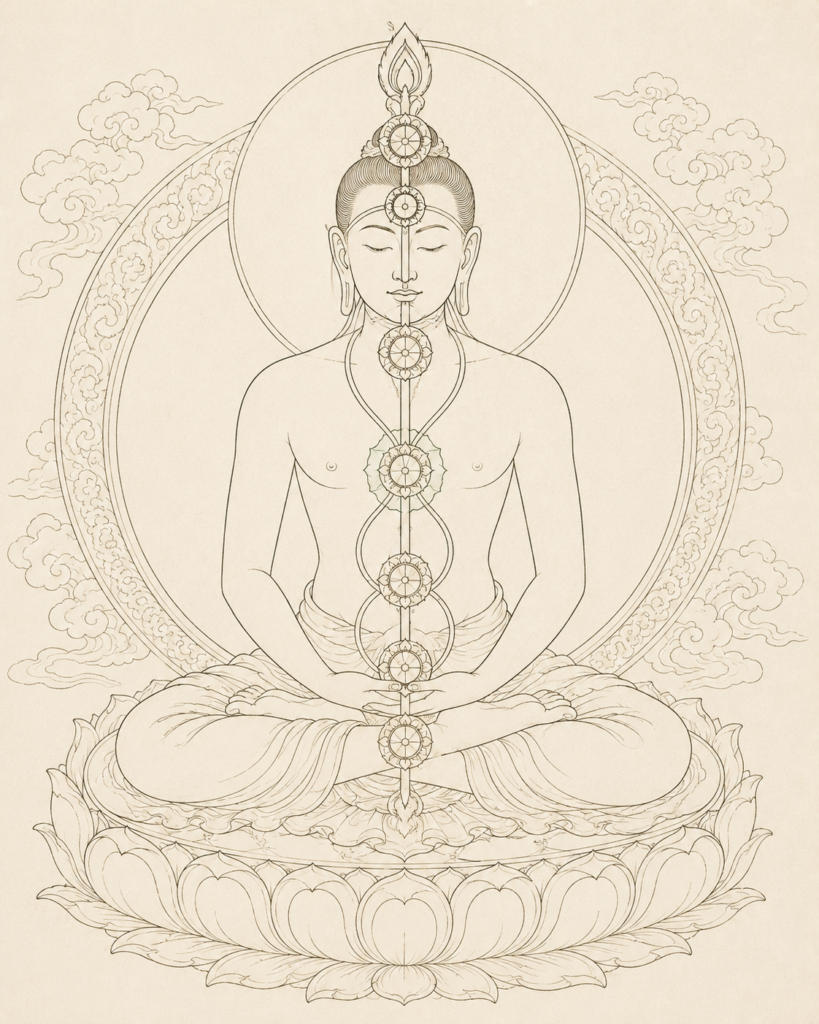
This illustration is inspired by traditional Tibetan subtle body imagery. Different Hindu and Buddhist traditions describe the subtle body in different ways, and there is no universally accepted chakra system.
The familiar seven chakras, with colours of the rainbow ranging from red at the base to purple at the crown, are a Western interpretation. Some Eastern traditions depict fewer chakras. The colours and symbols given to the chakras are quite complex and linked to elements of Eastern religions.
The simple rainbow is one way in which Westerners have made the chakra system more meaningful for those who were not raised Buddhist or Hindu. That is not to say there is anything wrong with rainbow chakras. But many people don’t realise that this depiction is just a recent stylistic variation.
Eastern religions identify a physical body and a subtle body in every person. Chakras are part of the subtle body. The subtle body is all about consciousness. Chakras are not part of our physical body in the same way that our heart, lungs, liver or other organs are.
When we die, the energy in our chakras dissipates. The chakras are sometimes envisaged as knots of energy, which are released or untied when we die.
By contrast, our physical organs do not disappear at the moment of death. They are far more solid and carry less innate consciousness.
In the classical Hindu and Buddhist traditions, the chakra system is a framework for meditation and spiritual growth. The goal is not to “fix” or “balance” the chakras as an end in itself, but to cultivate awareness, compassion, and wisdom. The ultimate aim is liberation from endless cycles of suffering.
In our context, the stress cycle is one such form of suffering.
The Western practice of paying someone to “balance” your chakras might seem quite strange or commercial to traditional Eastern teachers. They would be more likely to view the chakras as useful tools to support inner transformation. They are not like the wheels of a car that need adjustment or balancing for good performance. The value of chakras lies in how they help focus the mind and deepen spiritual practice.
Westerners have adapted the system to make it more comprehensible to them. It can be helpful to remember the original intention.